 By Saurav Mehra
 Chenab Railway Bridge is one of the greatest engineering achievements in India and the world’s highest railway arch bridge. Built across the Chenab River in the Reasi district of Jammu & Kashmir, the bridge forms a major part of the Udhampur–Srinagar–Baramulla Rail Link (USBRL) project. The bridge stands around 359 meters above the riverbed, making it even taller than the Eiffel Tower.
The bridge officially opened for railway traffic in June 2025 and now connects the Kashmir Valley with the rest of India through an all-weather railway network. It is widely considered one of the most difficult railway bridge projects ever constructed because of the Himalayan terrain, seismic conditions, and extreme weather challenges.
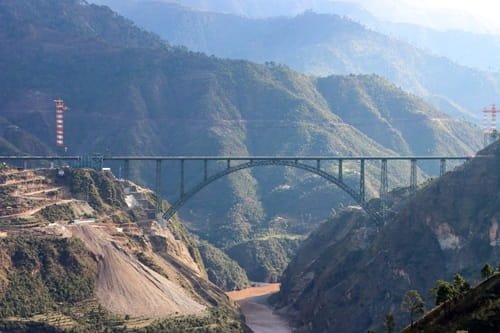
| Feature | Details |
| Official Name | Chenab Rail Bridge |
| Location | Reasi district, Jammu & Kashmir |
| Union Territory | Jammu & Kashmir |
| River | Chenab River |
| Opened For Rail Traffic | 2025 |
| Bridge Type | Steel deck arch railway bridge |
| Famous For | World’s highest railway arch bridge |
| Height Above River | Around 359 meters |
| Total Length | Around 1,315 meters |
| Main Arch Span | 467 meters |
| Nearby Areas | Kauri, Bakkal, Reasi |
| Main Project | USBRL Project |
Location of Chenab Railway Bridge
Chenab Railway Bridge is located in the Reasi district of Jammu & Kashmir between Kauri and Bakkal railway stations. The bridge crosses the deep gorge of the Chenab River in the Himalayan region.
Its location is strategically important because it connects the Kashmir Valley to the Indian railway network through the USBRL corridor.
Directions to Reach Chenab Railway Bridge
Reaching Chenab Railway Bridge involves travel through Jammu and the Reasi region.
By Road
Travelers can reach the bridge area from Jammu through Reasi district roads using taxis, buses, or private vehicles.
By Train
The nearest important railway access point is Shri Mata Vaishno Devi Katra Railway Station. The bridge itself forms part of the Katra–Banihal railway section.
By Air
Jammu Airport is the nearest major airport connected through road transport toward Reasi and Katra.
History of Chenab Railway Bridge
The Chenab Railway Bridge project was planned as part of the ambitious USBRL railway project designed to connect Kashmir with the rest of India through railways. Construction planning started during the early 2000s.
The project faced several challenges including:
- Harsh mountain terrain
- Deep river gorge
- High seismic activity
- Strong wind conditions
- Security concerns
Construction work was temporarily stopped in 2008 because of safety concerns and later resumed after design modifications.
The steel arch of the bridge was completed in 2021, while full construction finished in 2022. After successful trial runs in 2024, the bridge officially opened for rail traffic on 6 June 2025.
Structure and Design of Chenab Railway Bridge
Chenab Railway Bridge is a steel and concrete deck arch bridge specially designed for extreme Himalayan conditions.
Important design features include:
- Steel arch structure
- 17 spans
- Main arch span of 467 meters
- Total bridge length of around 1.3 km
- Blast-resistant design
- Earthquake-resistant engineering
The bridge was designed to withstand:
- Earthquakes up to magnitude 8
- Wind speeds up to 260 km/h
- Extreme temperatures
The bridge is expected to have a lifespan of around 120 years.
Importance of Chenab Railway Bridge
The bridge plays a massive role in India’s railway and strategic infrastructure.
The bridge helps:
- Connect Kashmir Valley with the Indian railway network
- Improve all-weather transportation
- Boost tourism
- Improve defense logistics
- Reduce travel time
The opening of the bridge also allowed the launch of Vande Bharat train services between Katra and Srinagar.
Nearby Areas Around Chenab Railway Bridge
Reasi
Reasi district is known for mountainous landscapes and religious tourism routes.
Katra
Katra is famous as the base town for the Vaishno Devi pilgrimage.
Banihal
Banihal is an important railway and tunnel region connected through the USBRL project.
Srinagar
The railway project now improves direct connectivity toward Srinagar and Kashmir Valley.
Engineering Challenges of the Bridge
Chenab Railway Bridge is considered one of the most difficult bridge construction projects in the world because of:
- Deep Himalayan gorge
- High seismic zone
- Difficult weather
- Remote mountain terrain
- Strong winds
Special high-strength steel and corrosion-resistant paint systems were developed specifically for this project.
More than 28,000 tonnes of steel and around six lakh bolts were reportedly used in construction.
Tourist Attraction and Scenic Beauty
Chenab Railway Bridge has become one of India’s biggest engineering tourism attractions because of:
- Massive arch design
- Deep river gorge views
- Himalayan scenery
- Train photography
- Modern engineering beauty
The bridge route through Kashmir is now considered one of the most scenic railway journeys in India.
Interesting Facts About Chenab Railway Bridge
- It is the world’s highest railway arch bridge.
- The bridge stands 359 meters above the riverbed.
- It is taller than the Eiffel Tower.
- The bridge officially opened for rail traffic in June 2025.
- It is part of the USBRL railway project connecting Kashmir with the rest of India.
Conclusion
Chenab Railway Bridge is one of the most remarkable railway engineering achievements in the world. Built high above the Chenab River in Jammu & Kashmir, the bridge symbolizes modern Indian engineering, strategic connectivity, and technological advancement.
Its record-breaking height, difficult construction conditions, and role in connecting Kashmir through railways continue to make Chenab Railway Bridge one of India’s greatest infrastructure landmarks.
FAQs About Chenab Railway Bridge
Q1. Where is Chenab Railway Bridge located?
The bridge is located in Reasi district of Jammu & Kashmir across the Chenab River.
Q2. Why is Chenab Railway Bridge famous?
It is famous for being the world’s highest railway arch bridge.
Q3. What is the height of Chenab Railway Bridge?
The bridge stands around 359 meters above the riverbed.
Q4. Which river flows below the bridge?
The Chenab River flows below the bridge.
Q5. When did Chenab Railway Bridge open?
The bridge opened for regular railway traffic on 6 June 2025.
Q6. What is the total length of the bridge?
The bridge is around 1,315 meters long.
Q7. Which railway project includes the bridge?
The bridge is part of the Udhampur–Srinagar–Baramulla Rail Link (USBRL) project.
Q8. Can the bridge withstand earthquakes?
Yes, it was designed to withstand strong earthquakes and extreme weather conditions.
Q9. Which train services operate through the bridge?
Vande Bharat train services between Katra and Srinagar now operate through the route.
Q10. Why is Chenab Railway Bridge strategically important?
The bridge improves railway connectivity, tourism, and defense logistics in Jammu & Kashmir.